Residential heating and cooling service in Wellington, FL — repair, installation and seasonal maintenance

Heating & Cooling Service

Heating and Cooling Solutions for Comfortable Spaces

Most comfort problems in a home start small — a vent that barely moves air, a thermostat that stops responding, a unit that runs without ever producing cold. We inspect the whole system, find the actual cause, and complete the service your equipment needs.

  • Uneven temperatures room to room
  • Weak airflow from supply vents
  • No cooling in peak summer
  • No heat during cold weather
  • Strange grinding or rattling sounds
  • Thermostat that will not hold a setting
  • Poor indoor comfort overall
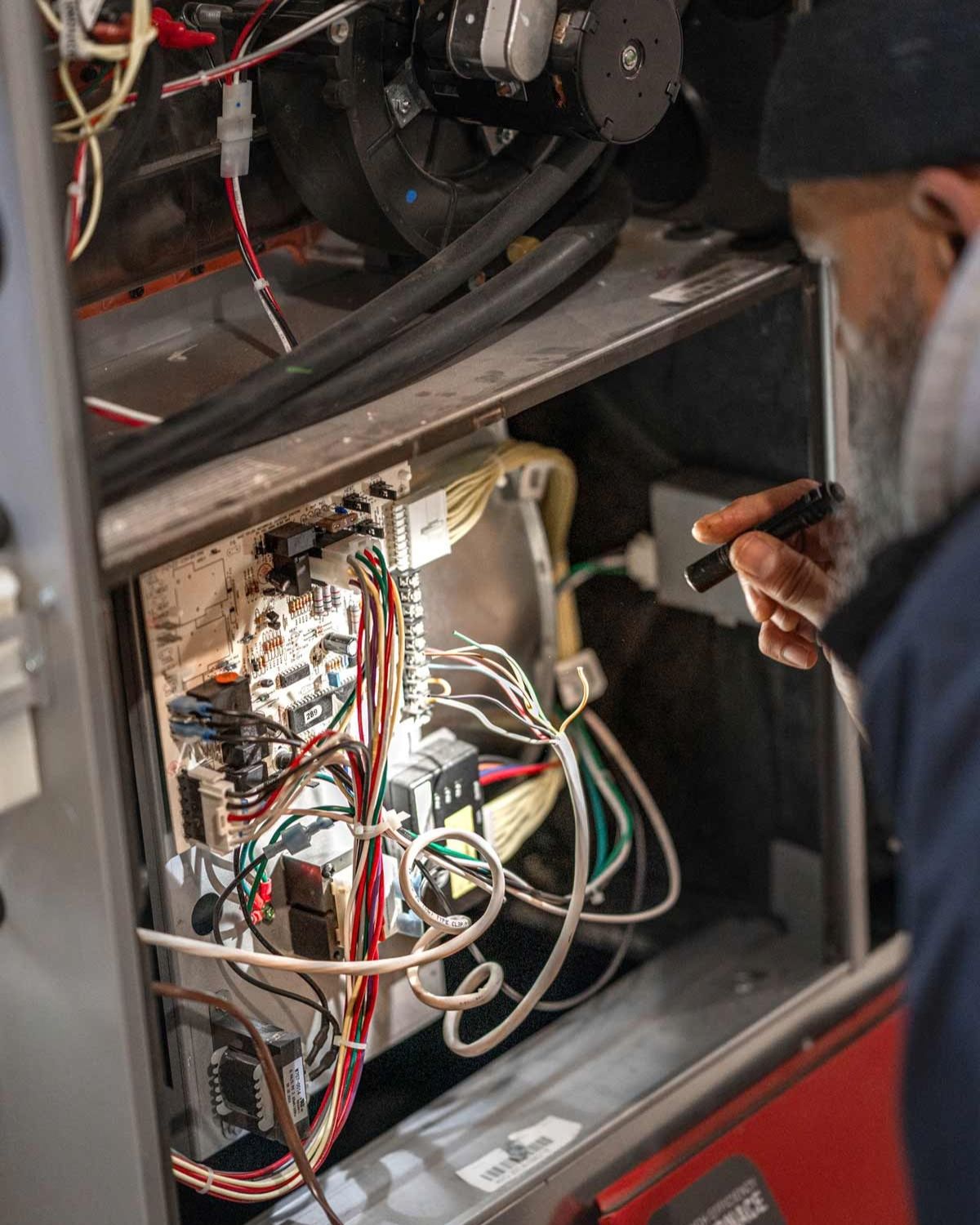
HVAC technician standing in front of a residential metal furnace unit during service
Close-up of a residential air conditioning condenser unit outdoors on a sunny day
  • CoolingCondensers, evaporators, refrigerant
  • HeatingFurnaces, heat pumps, air handlers
  • AirflowFilters, ductwork, vent delivery

Symptoms We Address

Common Problems and What Inspection Reveals

A household HVAC system is a connected set of parts. A symptom at one vent often traces back to equipment, airflow, controls, or the distribution system. Each situation below is first inspected, then matched to the service it actually needs.

01

AC Blowing Warm Air

A unit that runs but never cools out is often low on refrigerant, restricted by a dirty evaporator coil, or short-cycling on a failed component. Inspection checks airflow, coil condition, pressures, and control operation before the repair is chosen.

Leak testing, coil cleaning, refrigerant recovery, or control repair.

02

Furnace Not Producing Heat

No heat usually traces to the thermostat call, a tripped limit switch, a failed igniter, a blocked flue, or a blower that is not moving air. Each of these presents differently and only one of them may be the actual failure.

Igniter, limit switch, blower motor, or control board service.

03

Weak Airflow From Vents

Low air volume is a distribution problem more often than an equipment problem. A clogged filter, closed or blocked registers, disconnected flex duct, or a failing blower motor all reduce the air the system can deliver.

Filter service, register adjustment, duct repair, blower replacement.

04

Thermostat Not Responding

A thermostat that will not hold a setpoint, cycles constantly, or shows no call to the equipment may have wiring issues, a low-voltage transformer fault, or a failed control board. Thermostat problems are frequently equipment problems.

Wiring and transformer checks, thermostat or control board replacement.

05

Unusual System Noise

Rattling, grinding, squealing, or hissing each point to a different area. Rattling is often loose sheet metal or a failing blower wheel, grinding usually means motor bearings, and hissing points toward a refrigerant or airflow issue.

Blower motor, wheel, cabinet fasteners, fan belt, or refrigerant check.

06

Frequent System Cycling

Short cycling means the system shuts down before it reaches setpoint. Common causes include an oversized system, low airflow, a dirty coil, incorrect low-charge, or a failing pressure switch, and each one is resolved differently.

Airflow correction, coil service, control verification, refrigerant level.
Row of white residential air conditioning condensing units installed outdoors
Outdoor condensing unit photographed against a plain wall

About Our Work

What an HVAC System Is Made Of

An HVAC system is not a single appliance. It is a set of connected components that move heat in or out of a building and distribute conditioned air through the occupied rooms. When one part of that chain performs poorly, the whole system feels wrong, and comfort problems show up in places that do not obviously point to the equipment.

More Air HVAC Repair in Wellington, FL, service work starts by identifying the equipment in the home and understanding how the system is configured — whether cooling and heating are handled by one combined unit or by separate pieces of equipment.

  • Air ConditionersCooling equipment that removes heat and controls indoor humidity.
  • FurnacesHeating units that generate warm air for the duct system.
  • Heat PumpsMove heat rather than generate it, for both cooling and heating.
  • Air HandlersBlow conditioned air into the ductwork and control circulation.
  • ThermostatsThe control point where a set temperature is communicated to the system.
  • DuctworkCarry air from the equipment to the rooms that need it.
  • Outdoor Condensing UnitsThe exterior equipment that releases heat to the outside air.

HVAC Services

Service Categories We Work On

Service is matched to the equipment, the symptoms, and the condition found during inspection rather than applied by default.

Wall mounted indoor air conditioning unit running inside a room

Residential cooling and heating equipment has a limited service life under load, and the failure point is often visible in advance as a change in performance. Correct service means finding that change, confirming its cause, and completing the repair or installation the system needs.

Cooling

Air Conditioning Repair

Diagnosis of residential air conditioning systems that do not cool, run constantly, leak water, or trip off. Includes refrigerant leak testing, electrical checks, blower and motor service, and coil cleaning.

Cooling

AC Installation

Replacement and new installation of complete cooling systems, including load calculation, equipment selection, line set and refrigerant charging, drain line routing, pad preparation, and thermostat integration.

Cooling

AC Maintenance

Seasonal cooling service performed before warm weather: condenser and evaporator coil cleaning, filter service, refrigerant level verification, electrical inspection, drain line clearing, and operating check at full load.

Heating

Furnace Repair

Service for furnaces that will not start, do not hold heat, cycle short, or make unusual noise. Covers igniters, limit switches, flame sensors, blower assemblies, control boards, and gas valve operation.

Heating

Heating Maintenance

Pre-season heating service: burner and heat exchanger inspection, flue and venting check, filter replacement, blower inspection, safety limit testing, and thermostat calibration so the system starts cleanly on the first cold morning.

Heating & Cooling

Heat Pump Service

Inspection and repair of heat pump systems, including reversing valve operation, reversing control, defrost cycle, compressor current, and refrigerant charge. Serviced for both the heating and cooling side of the year.

Controls

Thermostat Service

Thermostat installation, replacement, and troubleshooting, including low-voltage wiring checks, transformer output, sensor calibration, and programming for the equipment actually installed in the home.

Airflow

Ductwork Service

Duct inspection, sealing of leaks and disconnected runs, register and grille balancing, and transitions where airflow is being lost between the equipment and the rooms it serves.

Sheet metal ductwork and air vent in a mechanical space
Sheet metal ductwork and vent registers
Heating system room with pipes, fittings, and pressure gauges
Piping and pressure gauge points in a heating system
Digital wall thermostat displaying a set temperature
The thermostat is the control point for the whole system
Group of outdoor AC units installed side by side
Outdoor condensing units and their installation space

Service Process

How HVAC Service Works

Four steps from the first description of the problem to the completed service.

  1. 01

    Describe the Problem

    You describe what changed — which rooms are affected, when it started, what the system is doing, and what you hear. This narrows the inspection before anyone opens a panel.

  2. 02

    Inspect the System

    The equipment, filter, airflow, thermostat call, and electrical components are checked under operating conditions to see what is actually happening inside the system.

  3. 03

    Identify the Cause

    Findings are separated from symptoms. Several faults can look identical from inside the home, so the cause is confirmed before any part is replaced.

  4. 04

    Complete the Service

    The specific repair, cleaning, or installation the system requires is carried out, then verified at operating conditions with airflow and temperature checked before leaving.

Seasonal Maintenance

Preparing the System for Each Season

Most comfort complaints appear at a season change, because that is when a system is asked to do full duty for the first time in months. Pre-season work targets the specific areas that carry the load in that season, along with the parts shared by both heating and cooling.

A maintenance visit covers the equipment, the air path, and the controls together, because a fault in any one of them stops the system from performing as designed.

Request Seasonal Service

Cooling Season

Coil cleaning, condenser clearance, refrigerant level check, drain line clearing, and a full-load operating test before hot weather.

Heating Season

Igniter and flame sensor service, heat exchanger inspection, venting check, blower inspection, and safety limit testing.

Thermostat Operation

Setpoint accuracy, schedule programming, sensor response, battery condition, and confirmation that calls reach the equipment.

Airflow

Static pressure and measured air volume at registers, so the system moves the air its equipment is designed to move.

Filters

Filter type and size verification, replacement on the correct interval, and confirmation that the filter rack is sealing properly.

Outdoor Equipment

Coil condition, fan operation, line insulation, pad stability, and clearance from vegetation and debris around the condensing unit.

Homeowner Notes

Practical HVAC Tips for Homeowners

Several common comfort problems are visible to a homeowner before they become failures. These checks take a few minutes and often show exactly where a problem is starting.

Air handling equipment mounted overhead showing how air is distributed
  1. 01

    Replace or inspect filters regularly

    A loaded filter restricts airflow and makes the system run longer for the same result. Check the filter rack monthly and replace on the interval the equipment requires, not the interval you remember.

  2. 02

    Keep outdoor equipment clear

    Leave clearance around the condensing unit. Leaves, grass, and debris drawn into the coil reduce airflow over the coil and raise discharge temperature during a period when the system is already working hardest.

  3. 03

    Check thermostat settings

    Confirm the mode is set correctly, the schedule matches how the home is actually occupied, and the setpoint is not pulling the system toward a temperature the house cannot hold.

  4. 04

    Watch for unusual sounds

    Grinding, squealing, rattling, or hissing usually changes before performance drops. Note when the sound happens — at startup, at shutdown, or only in one mode — because that detail narrows the diagnosis.

  5. 05

    Pay attention to uneven temperatures

    Rooms that never reach setpoint are usually an airflow distribution issue — closed registers, undersized ducts, or a disconnected run — rather than a capacity problem.

  6. 06

    Do not ignore repeated system cycling

    A unit that starts and stops without reaching setpoint is working harder for less output and shortening component life. Short cycling has specific causes that inspection can identify.

Contact

Schedule HVAC Service with More Air HVAC Repair

More Air HVAC Repair handles residential heating and cooling work throughout Wellington, FL — air conditioning, furnaces, heat pumps, air handlers, thermostats, ductwork, and outdoor condensing units. Describe what the system is doing and which rooms are affected, and we will arrange an inspection, confirm the equipment involved, and complete the service the system needs.

Call +1 728-231-5431